EN

Riyadh Limestone Quarry: Belt Life 2–3 Months to 12+ Months
Quick answer
A limestone quarry in Riyadh, Saudi Arabia was replacing its conveyor belt roughly four times a year, with each belt lasting only 2–3 months. After BEDROCK specified an EP900/3 conveyor belt with a 24 MPa, DIN-X grade abrasion-resistant cover, the belt reached more than 12 months of service and annual replacement dropped from about four times to once.
Project overview
In 2025, a limestone quarry in Riyadh partnered with BEDROCK to upgrade the conveyor system in its crushing section. The line transports crushed limestone continuously, under high impact and heavy load, from the crusher discharge point along the main conveyor.
The quarry had been running locally supplied belts built on a 5–6 ply carcass with a rubber cover strength of only 6–8 MPa. Under those conditions the belts failed early and repeatedly.
The problem: 2–3 months per belt, four replacements a year
- Surface wear and impact damage at the crusher discharge point
- Belt misalignment along the main line
- Premature replacement, on average every 2–3 months
- Roughly four belt changes per year, each one carrying downtime and labour cost
- Low purchase price, but high total cost of ownership
The quarry's real requirement was not a cheaper belt. It was a belt that could survive the crushing environment long enough to stop the replacement cycle.
The BEDROCK solution: EP900/3, 24 MPa, DIN-X
After a site evaluation covering material abrasiveness, discharge geometry and operating load, BEDROCK recommended:
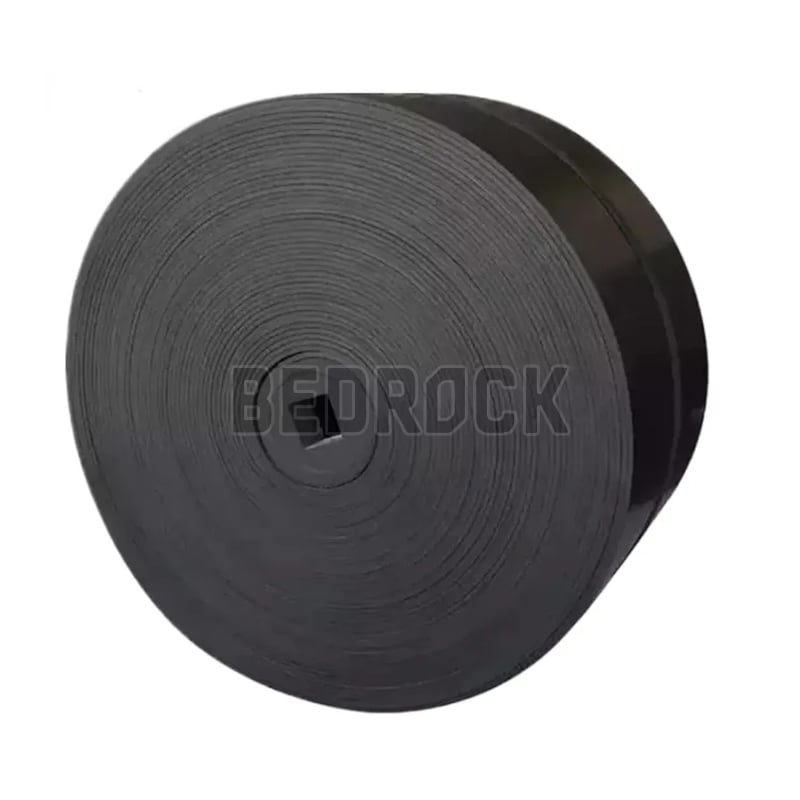
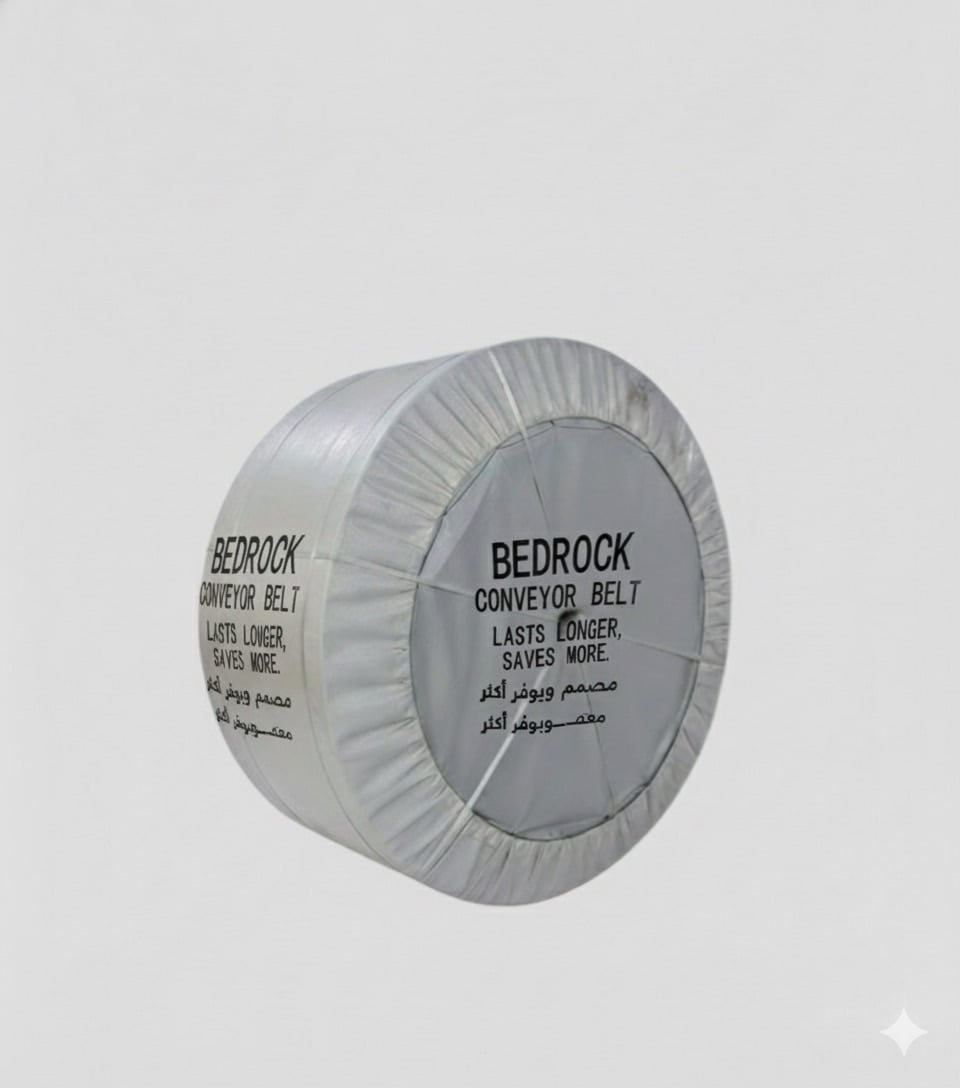
BEDROCK EP900/3 · 24 MPa · DIN-X Grade abrasion-resistant conveyor belt
Why this construction works at a crusher discharge point:
- 24 MPa high-strength cover rubber resists the sharp, high-energy impact of crushed limestone
- DIN-X premium abrasion resistance slows cover wear — the dominant failure mode in limestone conveying
- EP900/3 high-tensile carcass holds the belt under heavy load without excessive stretch
- Enhanced impact and tear resistance at the point where material lands hardest
BEDROCK also supported the customer locally with belt selection, installation recommendations and long-term maintenance guidance.
Before and after
Results
- Belt service life increased from 2–3 months to at least 12 months
- Annual replacement frequency fell from approximately four times to once per year
- Maintenance-related downtime reduced
- Labour and replacement costs lowered
- Crushing line continuity improved
- Long-term total cost of ownership reduced
The unit price more than doubled. The number of annual replacements fell by roughly 75%. That trade is what changed the operating economics.
What this project proves about belt selection
The belt that fails first is usually the belt that was specified cheapest, not the belt that was specified wrong for the material. In limestone crushing, three variables decide service life — cover rubber strength, abrasion grade, and carcass ply — and all three must be matched to the discharge point, not to a catalogue price.
Frequently asked questions
How long should a conveyor belt last in a limestone quarry? Under proper maintenance and correct specification, BEDROCK belts in comparable Saudi quarry applications are typically designed for 1–2 years of service. Where belt life falls to 2–3 months, the specification — not the maintenance schedule — is usually the root cause.
Is a 24 MPa cover necessary, or is it over-specified? It depends on the impact energy at the discharge point. For a 400 TPH limestone crusher line with sharp-edged material, a 6–8 MPa cover wears through long before the carcass is exhausted. A 24 MPa DIN-X cover addresses the actual failure mode.
What does DIN-X grade mean? DIN-X is the highest abrasion-resistance class in the DIN 22102 cover-grade system. It is specified where abrasive material — crushed stone, clinker, iron ore — causes rapid cover wear.
Does a higher-priced belt always reduce total cost? No. It reduces total cost only when the cheaper belt's failure interval is short enough that replacement frequency, downtime and labour outweigh the unit-price difference. In this project the belt cost 2.2× more per metre and was replaced 75% less often.
How is the belt spliced, and does the joint limit belt life? BEDROCK hot vulcanized splicing achieves a splice efficiency above 90%, bringing joint strength close to that of the belt body itself. The joint is therefore not normally the limiting factor — cover wear at the discharge point is.
Can BEDROCK supply and support this in Saudi Arabia? Yes. BEDROCK is based in Dammam and supports Saudi operations with belt selection, installation guidance, on-site hot vulcanizing service and a local spare parts stock, with remote technical support within 24 hours.
What information is needed to specify the right belt for my quarry? Material type and lump size, conveying capacity in TPH, belt width and speed, discharge-point geometry, ambient and material temperature, and the current belt's failure interval and failure mode.
Contact
Facing short belt life or repeated replacements? Send your site conditions to BEDROCK for a belt selection review.
WhatsApp: +966 56 171 7029 · Email: [email protected] · Dammam, Saudi Arabia